Start a Bangkok food trip with three contrasting meals: chicken rice, pad Thai and a shared meal built around papaya salad and grilled food. Add a Chinatown evening or a food-court lunch according to your route. You will learn more by comparing dishes and ordering carefully than by crossing the city to collect famous restaurant names.
The recommendations below are based on menus, official tourism information and practical differences between venues, not personal tasting. They deliberately mix a specialist noodle restaurant, a chicken-rice stop, a broader regional menu and an easy food-court option. None should become a compulsory detour when another good meal fits your day.
Chicken rice: an uncomplicated first order
Khao man gai is a useful starting point because the central components are easy to recognise. Thailand's tourism authority describes Go-Ang Kaomunkai Pratunam's version as boiled chicken with rice cooked in chicken stock, served with its own sauce. Its listing identifies the Pratunam restaurant on Phetchaburi Road. 1
Choose this meal when you need a clear, focused order rather than a long menu discussion. Ask how the sauce is served and start with a little if you are uncertain about it. For a mixed group, give each person control over their own sauce instead of seasoning every plate alike.
Do not turn a restaurant's reputation into a promise about queues or service speed. Build it into a Pratunam-area outing, then decide whether the wait suits your appetite. A meal is a better experience when you are choosing it willingly rather than arriving hungry after an expensive cross-city journey.
Chicken rice also demonstrates why a simple-looking dish is not automatically compatible with a particular diet. The rice preparation matters, not just the visible meat. When ingredients are important, ask about the entire plate and its sauce.
Pad Thai: read beyond the photograph of the noodles
Thipsamai's published menu distinguishes basic and vegetarian pad Thai from versions made with shrimp oil, egg and prawns. Its main address is 313–315 Mahachai Road. That range makes it a useful place to compare what a dish name leaves unspecified. 2
For a first order, choose the version whose ingredients and portion description make sense to you. More expensive prawns do not automatically make the meal more interesting for every diner. Likewise, a photograph of noodles without visible seafood does not establish that the preparation contains no shrimp-derived ingredients.
A vegetarian menu label is useful, but an allergy requires a separate conversation about ingredients and preparation. Ask the restaurant to confirm what it can accommodate. Removing a topping is not the same as changing the oil, sauce or utensils used for the dish.
My practical recommendation is to make pad Thai one meal, not the default order for the whole trip. On another day, compare a rice dish or a broth-based noodle meal. That small change brings more variety than ordering the same familiar plate at five different venues.
Papaya salad works best as part of a shared meal
Baan Somtum's menu shows how misleading it is to treat som tam as one fixed recipe. Alongside Thai papaya salad, it lists versions with salted egg, salted crab, fermented fish and other additions. The same menu includes grilled chicken, pork neck and sticky rice. 3
For two people, I would begin with one salad, one grilled dish and rice, then add another plate if needed. This is a suggested ordering approach, not a set menu. It avoids buying several substantial salads before understanding their size and intensity.
Read the full dish description before choosing. Someone curious about a fermented-fish version may want a different experience from someone seeking a first introduction to papaya salad. Neither preference requires an argument about which diner is eating "properly."
Chilli tolerance should be discussed when ordering, not after the dish reaches the table. Describe what you can manage and ask the staff which preparation is suitable. Do not assume that a dish will be mild because it contains fruit, or that every restaurant interprets a translated spice request identically.
A shared table works especially well when you deliberately vary texture and preparation. Choose one grilled item and one salad rather than several nearly identical dishes. Give the rice a role in the meal instead of treating it as an afterthought.
Use Chinatown for an evening of small decisions
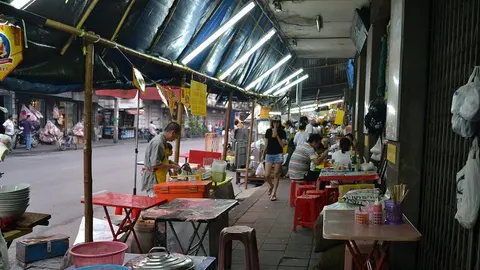
The Tourism Authority of Thailand identifies Yaowarat as an evening street-food destination and points to choices including rolled noodles, seafood and Chinese desserts. That is a reason to explore the area, not evidence that every named stall operates every night or that an old itinerary remains a current timetable. 4
Arrive with a short list of things you would like to try, but leave space for what is actually available. My suggested approach is one savoury stop followed by a second smaller dish or dessert. Commit to each purchase after seeing the portion and price.
For seafood, establish the charging basis before ordering. A price may refer to a plate, an individual item or a weight. Ask for the total for the selected item and the cooking method. This is more useful than trying to memorise a supposedly universal Bangkok seafood price.
Do not buy a full meal at every stop just to reproduce a food-tour checklist. Two people can often explore more sensibly by ordering gradually and sharing where appropriate. Ask before occupying a table belonging to one vendor while eating purchases from another.
Leave time for walking between meals. A neighbourhood food evening should not become a queue endurance contest. When the first stop absorbs most of your available time, simplify the rest rather than eating hurriedly to complete the plan.
A food court is a useful choice, not a failed food adventure
Pier 21 is on the fifth floor of Terminal 21 Asok. The mall's directory lists vendors for dishes such as chicken rice, pad Thai and oyster omelette, noodle soups, congee and vegetarian food. This gives a mixed group several directions without requiring separate restaurant journeys. 5
I would use it for a first independent lunch, a group with different appetites or a day when shopping already brings you to the building. Walk through the stalls before ordering. Seeing the full selection can prevent a large first purchase from crowding out the dish you actually wanted.
Read the current payment instructions at the counters and keep any payment card or receipt until you have finished. Do not assume that an arrangement described in an old blog still applies. The same principle covers portion sizes and prices: the displayed menu is the relevant offer.
A food court can also help you identify a dish to seek elsewhere. Note its Thai name or photograph the menu with permission. That is a more useful souvenir than a generic list of "must-eat" foods you never learned to recognise.
Build a satisfying day, not a competitive eating schedule
For a manageable food-focused day, choose one anchor meal and leave the others flexible. A chicken-rice lunch followed by an evening in Chinatown is one possibility. A pad Thai stop and a shared regional dinner is another. These are alternative plans, not instructions to fit every venue into a single day.
Set a meal budget separately from transport and drinks. An inexpensive dish ceases to be an inexpensive outing when it requires a long dedicated journey. Where a famous restaurant fits naturally, enjoy the opportunity; where it does not, use the dish as the starting point and find a workable venue.
Finally, make dietary communication specific. Mention the ingredient you need to avoid, show a clear translation when useful, and accept that a kitchen may be unable to make the requested change. Bangkok offers many possible meals; forcing one unsuitable order is not necessary to have a rewarding food trip.