Wat Pho is worth visiting for more than its reclining Buddha: choose it for a substantial temple visit combining religious art, courtyards and the history of public learning. It is particularly rewarding when you leave time beyond the famous hall. A rushed photograph between other major attractions gives you much less of what the complex offers. 12
What makes the visit more than one large statue
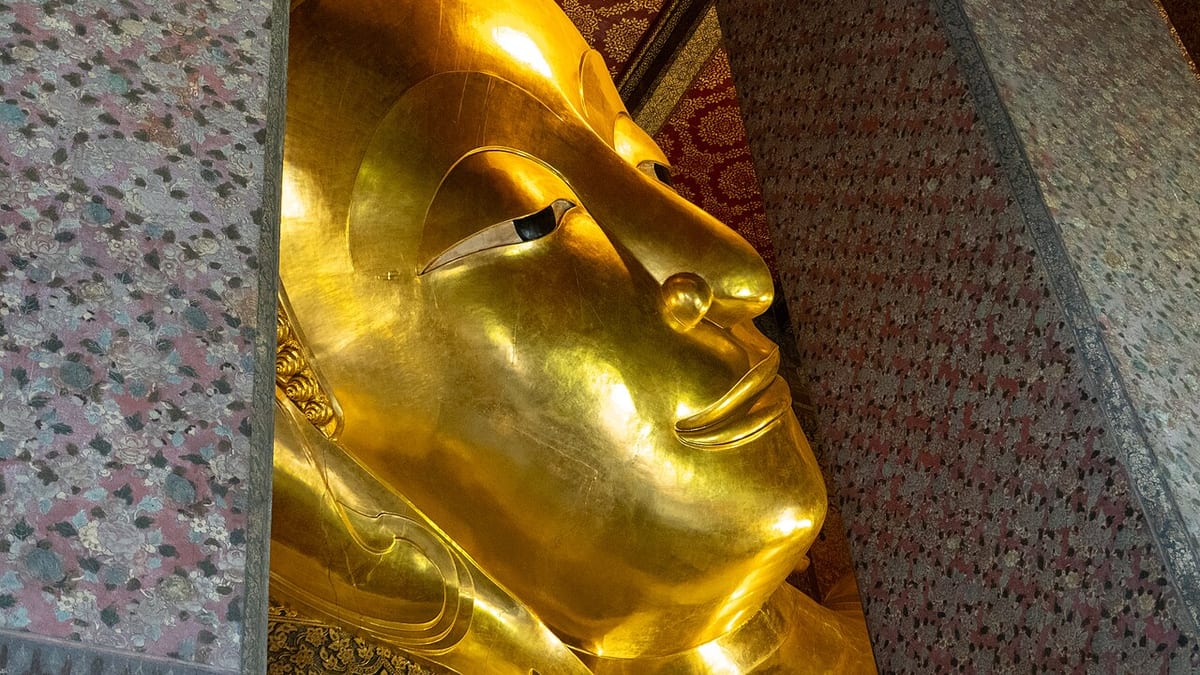
The reclining Buddha is the obvious reason to come. Thailand's official 2026 meetings visitor guide gives its dimensions as 46 metres long and 15 metres high. Its mother-of-pearl feet depict 108 auspicious characteristics. The scale is impressive, but allow attention for the decoration around it rather than treating the hall as a single camera angle. 3
Wat Pho's own architectural account describes the surrounding mural programme, including stories associated with Buddhist disciples and Sri Lankan Buddhist tradition. The hall is therefore both a setting for an enormous image and an illustrated religious space. Looking at a few panels closely can be more satisfying than trying to photograph every surface. 1
Outside, the four royal chedi provide a different experience. These 42-metre monuments use distinctive coloured ceramic decoration and commemorate the first four Chakri kings. They reward looking from several positions: their profiles read clearly from farther away, while the mosaic work becomes the attraction at close range. 4
The other reason to slow down is less immediately photogenic. The temple preserves 1,440 stone inscriptions dating from 1831–1841, bringing together religious and secular knowledge for public access. That history explains why Wat Pho matters as a place of learning as well as worship. You need not read every inscription to recognise that the complex was designed to communicate knowledge, not simply display wealth. 2
For an independent visitor, these three threads - religious imagery, royal architecture and public education - make a useful framework. Choose one detail from each rather than attempting a room-by-room checklist. A guide becomes more worthwhile when you want those meanings explained, not merely someone to lead you towards the Buddha.
Admission, opening hours and a sensible visit length
The temple currently publishes admission of THB 300, with free entry for children under 120 centimetres, and visiting hours of 08:00–19:30. Those are the temple's published arrangements, rather than the earlier closing times reproduced by some third-party guides. 5
I would allocate roughly 90 minutes to two hours for an unhurried first visit, excluding a massage. That is a planning allowance, not a measured average. An hour can work when the reclining Buddha is your main interest; a longer stay makes sense when you enjoy architecture or have arranged interpretation.
The useful question is not whether you can fit Wat Pho between two other tickets. It is whether you will still have the energy to appreciate it. Bookending the visit with another large temple complex and a long riverside walk can turn attractive courtyards into somewhere you simply want to escape.
An early arrival is my preference for a temple-focused morning. A later visit can suit someone who wants a slower afternoon, but opening hours alone do not guarantee identical access to every religious space throughout the day. Keep any essential activity near the start rather than leaving it until your final minutes.
Budget the entrance separately from transport, food, guiding and massage. Buying a tour that includes several Bangkok landmarks is a different purchase from ordinary temple admission; examine its inclusions before concluding that the higher price is an entrance charge.
Is the massage worth adding?
A massage can make sense when you are genuinely interested in Wat Pho's traditional treatment setting, but it should be a deliberate extra rather than something squeezed into a tight sightseeing schedule. The temple lists traditional Thai and foot massage at THB 340 for 30 minutes, THB 520 for 60 minutes and THB 1,040 for 120 minutes, separate from admission. 5
For example, one adult paying the published entrance and choosing a 60-minute traditional Thai massage would spend THB 820 before transport or food. That is a calculation from two listed charges, not a package offer. Adding the treatment also adds at least the treatment duration to your visit, before any waiting or preparation.
Do not select a treatment purely because it appears on a famous-site checklist. Consider whether you actually enjoy massage and communicate your preferences directly. This guide makes no medical claim about the treatments or their suitability for individual conditions.
For a couple travelling together, decide beforehand whether both people want the same activity. One person sitting through a lengthy wait while the other receives a treatment may be a poor use of a short Bangkok stay. Separating the temple visit from a later treatment appointment can be the cleaner plan.
How to enjoy the temple respectfully
Wat Pho asks visitors to dress modestly and remove shoes when entering religious buildings. Wear something that works for both outdoor walking and temple interiors, rather than relying on an improvised cover-up that repeatedly slips out of place. Shoes that are easy to remove make repeated transitions simpler. 5
Treat people praying as participants in the site, not scenery. Wait for space instead of stepping into someone's line of worship for a photograph. Keep a small number of purposeful photographs rather than spending the whole hall looking through a screen.
With children, give the visit a few concrete things to notice: differences between the chedi, decorative patterns and the contrast between an enormous image and tiny surrounding details. That is usually a more manageable approach than expecting sustained interest in every historical explanation. The height-based admission concession is worth knowing, but it does not determine how much walking a child will enjoy.
For anyone who needs a gentler visit, reduce the number of separate attractions that day. An itinerary with fewer destinations leaves more flexibility for seating breaks and a slower pace. Request practical access information for your own needs from the temple rather than assuming that a generally visitable courtyard proves every threshold is equally accessible.
Who should prioritise Wat Pho - and who can skip it?
Prioritise it when you want one Bangkok temple that supports both a striking first impression and a more thoughtful look afterwards. It is also a strong choice for travellers who prefer exploring a religious complex to attending a scheduled performance or shopping experience.
You can reasonably skip it when temples do not interest you, when your itinerary already contains several similar stops you are more excited about, or when reaching it would consume a disproportionate part of a very short layover. Famous does not automatically mean essential for every traveller.
The best compromise is to make Wat Pho the main cultural visit of one morning, not a compulsory stop on an overloaded circuit. See the reclining Buddha, spend real time outside its hall and let the inscriptions or chedi give the visit a second subject. That is where the entrance fee buys more than a recognisable photograph.