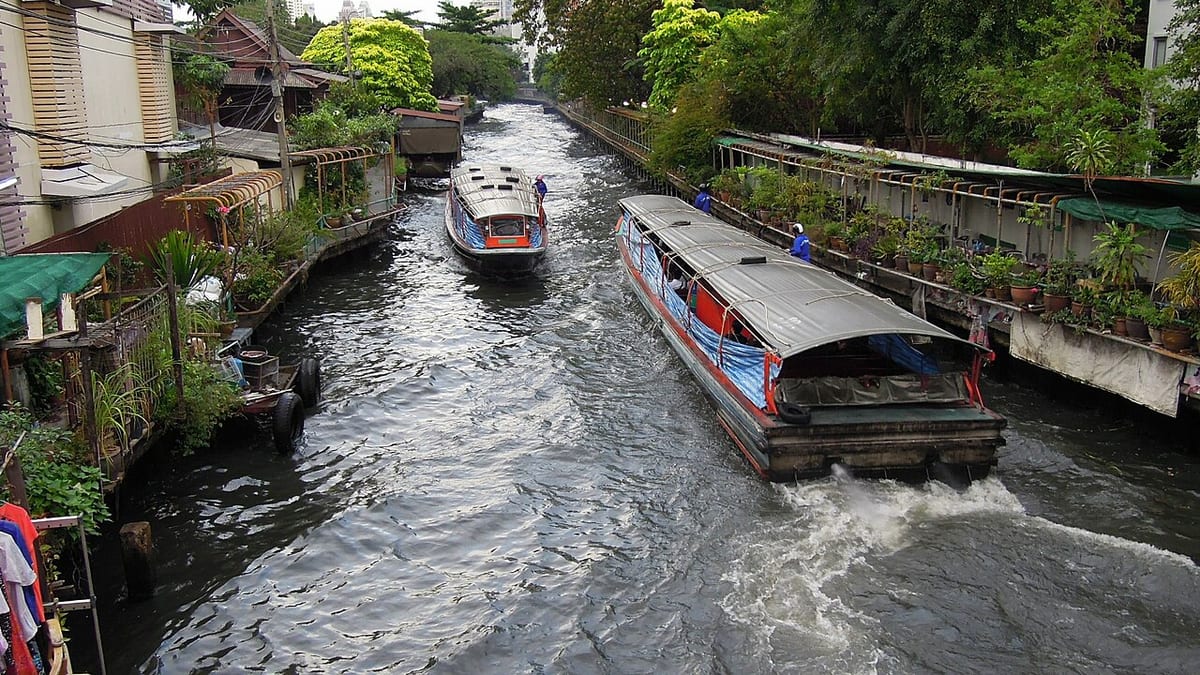
The Saen Saep canal boat is most useful for travelling between Pratunam and the old-town edge near the Golden Mount, or continuing east along the canal. Choose it for a practical cross-city journey rather than a leisurely river cruise. The important decisions are your boarding pier, direction and whether you need to change boats at Pratunam. 1
A short western-section ride makes a sensible first experience. You can learn how boarding and ticket collection work without committing to a long trip through unfamiliar stops. Thailand's tourism authority specifically recommends the Pratunam-to-Phan Fa journey as the beginning of a Golden Mount walking itinerary. 1
Understand the two sections before boarding
The central passenger route links Phan Fa Lilat, also written Panfa Leelard, with Pratunam, then continues east towards Wat Si Bun Rueang. Pratunam is the crucial dividing point. The Marine Department identifies the eastern section as an important commuter connection into central Bangkok. Do not assume that a boat approaching the pier will take you through both sections without a change. 2
For sightseeing around the Golden Mount, look for the western service towards Phan Fa. For destinations beyond Pratunam towards the eastern neighbourhoods, confirm the appropriate boat with staff. Showing a saved pier name is more reliable than asking for a large district whose nearest landing might not be obvious.
The route is not a substitute for the Chao Phraya boats. A canal ride towards the old town does not drop you at Wat Arun or the Grand Palace. Those require an onward journey. Treat the canal and river as different transport corridors, even when both appear in the same sightseeing plan.
Pratunam's value is its connection with the shopping district, rather than its being a seamless railway interchange. The Berkeley Hotel identifies the nearby landing as a useful canal transport point. Budget walking time between your hotel, the pavement entrance and the actual boarding area, not merely between two map pins. 3
Which stops make sense for a visitor?
For the simplest outing, board at Pratunam and stay aboard to the western terminus. The tourism authority's suggested walk continues to Wat Saket, the Golden Mount, and nearby food stops. This is a better first ride than trying to recognise an intermediate landing while the boat is already approaching it. 1
The approach also keeps the afternoon flexible. Explore the temple area, then choose whether to continue on foot, use another transport connection or return by canal. You need not make a complete out-and-back trip merely because you bought a boat ticket in one direction.
For a hotel-to-attraction journey, identify the landing on both ends before deciding that the canal is fastest. A direct-looking water route can lose its advantage if the final walk is long or awkward. Conversely, a short walk to a pier may be worth taking when the alternative requires several railway changes.
Do not use the canal's entire length as a sightseeing checklist. The useful question is which part serves your plans. A compact morning combining a boat ride and one old-town attraction is often more satisfying than spending a large share of the day travelling to an eastern terminus without a particular destination.
Tickets, cash and changing fares
Bring small Thai-baht notes and coins, and tell the conductor the pier you need. Keep the ticket until your journey, including any instructed transfer, is complete. Ask at Pratunam before discarding it or paying again; the staff's directions should govern your particular connection.
Avoid budgeting from an old article's headline fare. Canal prices have changed with fuel costs: Thai PBS reported an operator-announced increase in March 2026. That report establishes that older fixed ranges can become obsolete, not a reliable fare quotation for every subsequent month. Use the currently displayed fare for your destination. 4
No independently verified, complete October 2026 operator fare table was available for this guide. That is why there is no invented "current" price grid here. Take enough small cash for both directions and any separate onward transport rather than relying on an exact amount copied from a blog.
A reasonable budgeting method is to separate the journey into parts: canal ticket, attraction entry and return transport. The boat may be inexpensive relative to the rest of the outing, but a late taxi home can matter more than a small difference between fare bands.
There is little reason to buy a complex sightseeing package solely to cover this local ride. Pay for the transport you need and reserve advance booking for an attraction or guided experience that actually benefits from it.
Boarding is the main practical consideration
Plan to travel with a small, closed bag and shoes that remain secure when stepping between the landing and boat. Put your phone away while boarding. Keep both hands available and follow the crew rather than trying to film the movement from the edge.
This is a working passenger service, not a promise of level boarding or step-free access. Anyone who needs a wheelchair-accessible route, substantial assistance or room for large luggage should obtain specific confirmation before making the canal essential to the day. A taxi or a confirmed accessible rail route may be the better choice.
Stay clear of the boarding edge until directed forward. Once seated, keep belongings within your own space and avoid obstructing people getting off. Move promptly when it is your stop, but never jump because other passengers seem confident doing so.
With children, decide in advance who handles the bags and who supervises boarding. A short ride with an adult available for each child is easier to manage than a complicated transfer during a busy period. Do not make the ride a test of bravery for someone uncomfortable with moving boats.
Choose the canal for the right journey
For a sightseeing first ride, I would choose daylight outside the main commuter peaks and keep the schedule loose. This is planning advice, not a claim that a particular departure is always empty. Leave room to skip a crowded boat or use another route without losing an expensive reservation.
Weather and water conditions can change the appeal of the journey. Protect belongings from spray and rain, and do not treat a covered passenger area as a guarantee of a dry trip. When heavy rain or difficult boarding would undermine the day, choose the land route without trying to recover the experience at any cost.
A strong plan is Pratunam, a western canal ride, the Golden Mount area and lunch, with the return decided afterwards. A weak plan strings together several distant temples and assumes every transfer will be immediate. The boat works best when it solves one clear transport problem and leaves you time to enjoy the place where you get off.