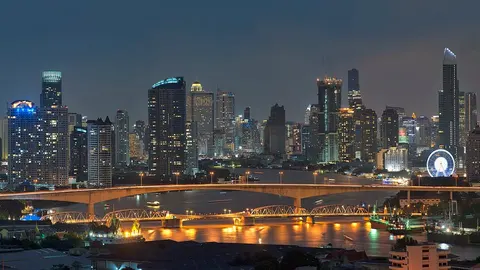
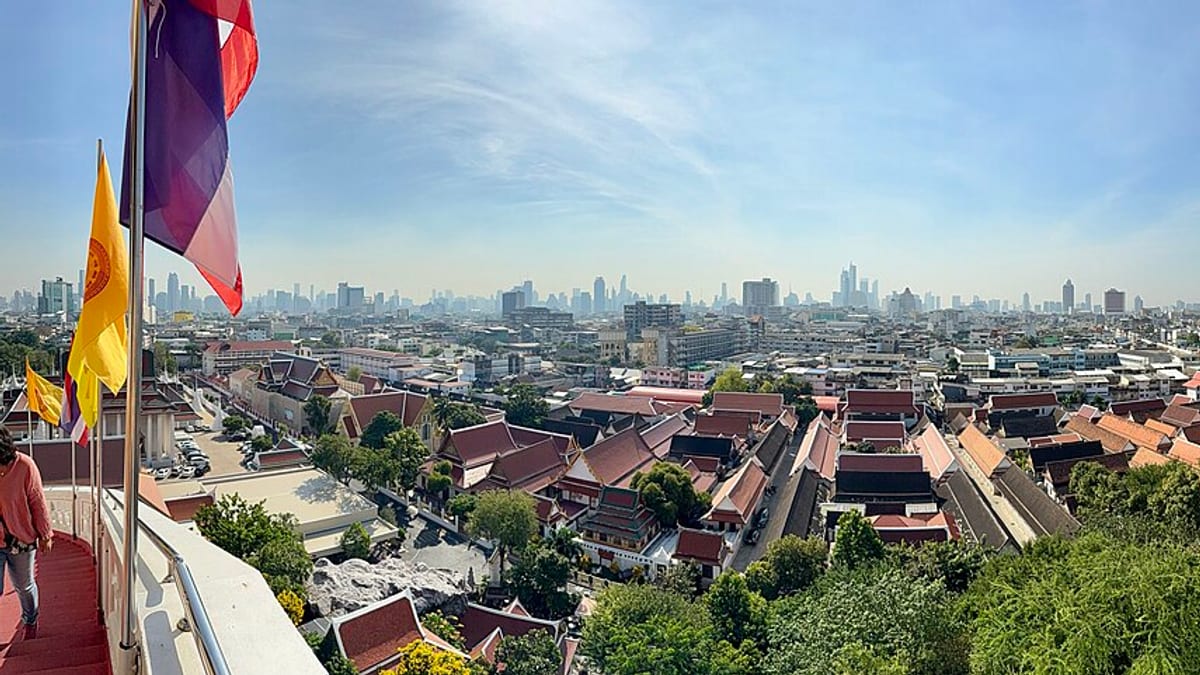
For parking in Bangkok, use a clearly signed garage or your hotel's designated parking unless you understand the street restrictions at the exact location. Mall validation and MRT park-and-ride can reduce costs, but neither works automatically. Decide where to leave the car for a block of activities rather than assuming you will find a convenient bay at every stop. [1][2][3]
A rental car is most useful when it serves a journey you actually need to make. Once you have reached your accommodation, compare leaving it there and using rail with repeatedly moving it between sightseeing stops. The cheapest individual parking space is not necessarily the simplest way to organise the day.
Kerb colours are a warning to read further
Thai police guidance identifies red-and-white kerbs as no-stopping and no-parking areas. Yellow-and-white markings prohibit parking while allowing only brief, prompt passenger or goods loading. Black-and-white markings improve visibility and do not establish unrestricted parking; local time or odd/even-day conditions can still apply. [1]
For a visitor, the important distinction is between stopping briefly and leaving a car. Waiting while someone shops is not the same as immediately dropping off a passenger. Hazard lights should not be treated as permission to occupy a restricted section.
Read nearby signs and consider the full space, including driveways and access routes. An apparently empty stretch is not proof that parking is permitted, and another driver's decision is not a reliable interpretation of the rule.
When you cannot understand a restriction, choose a properly identified car park rather than taking a chance on a short stay. It is easier to compare a displayed garage tariff than to resolve a clamped or removed rental car in an unfamiliar city.
Mall parking: the first free hours are only the beginning
Siam Paragon publishes a useful example of how a shopping-centre tariff works. For cars, the first two hours are free; subsequent hours cost THB 30, increasing to THB 60 per hour from the seventh hour. Qualifying receipts of THB 800, THB 3,000 and THB 6,000 extend free parking to four, six and eight hours respectively. [2]
Using the basic tariff and complete hours, a six-hour visit without validation would cost THB 120. An eight-hour visit would cost THB 240: four hours at THB 30 and two at THB 60 after the initial free period. These are worked examples, not a promise about rounding for a visit that runs beyond a full-hour boundary.
The receipt threshold matters only when you were already going to make the purchase. Spending THB 800 solely to avoid a modest parking charge is not a saving. Keep eligible receipts from planned shopping or dining and ask the information desk how validation must be completed before returning to the car. [2]
Do not transfer Siam Paragon's conditions to another mall. The tariff, free period, eligible purchases and stamping process belong to that operator. Similarly, a cinema benefit or membership privilege may require a specific qualifying transaction rather than simply entering the building.
For dinner or a late event, establish the vehicle exit arrangements separately from the shopping hours. A good daytime parking choice may be inconvenient if the pedestrian route back to the garage changes after shops close.
Park-and-ride can work - but prove you used the train
MRTA announced 24-hour parking at its Blue and Purple Line park-and-ride facilities in July 2025. Its published Blue Line tariff for MRT users is generally THB 15 per two hours, with THB 10 per two hours at Lak Song. Non-MRT users generally pay THB 50 per hour, with a lower exception at Lak Song. [3]
For a six-hour stay at a facility charging the standard Blue Line rates, that is THB 45 for an eligible MRT user versus THB 300 at the non-user hourly rate. The calculation explains why validation matters more than a small difference between nearby garages.
BEM's guidance tells passengers to validate the parking smart card at the MRT station where they alight. [4] Ask staff how the current process applies to your parking facility and fare medium. Simply possessing a train ticket is not a reason to assume the parking discount will appear without the required step.
Choose a facility that makes sense for your arrival direction and destination. Park-and-ride is less compelling if reaching it requires crossing the area you were trying to avoid driving through. Compare the transfer and final walk with parking once near your actual activities.
Round-the-clock parking does not mean round-the-clock train service. Keep the return train plan separate from the ability to collect the car. An accessible garage after midnight will not provide a train that is no longer running.
Hotel parking needs a precise question
Before booking accommodation with a car, ask whether parking is included, whether spaces are reserved or first come, first served, and whether the vehicle dimensions are acceptable. A general "parking available" label does not answer all three.
Give the hotel your arrival time and ask for the vehicle entrance rather than navigating to the lobby's pedestrian pin. This is particularly useful when you are tired after a flight and would otherwise circle the same block while trying to identify the correct ramp.
For a large rental vehicle, confirm clearance before entering any garage. Do not wait until you are halfway down a ramp to discover that a roof box or tall vehicle is unsuitable. Keep the car's dimensions available from the rental paperwork rather than guessing from its appearance.
Also establish whether leaving and returning creates a new paid session. A room rate with parking, a discounted ticket and a one-time shopping validation are different arrangements. Only the property or operator can confirm what your booking includes.
Keep enough information to solve a problem
Photograph the level, zone and bay number when you leave the car, and keep the parking ticket with you rather than losing track of it inside shopping bags. Save the garage's name and entrance pin; a mall may have more than one entrance that looks familiar when you return.
Before collecting the vehicle, complete any required validation and identify the payment method. Do not assume every machine accepts your preferred card or that an exit barrier is the correct place to resolve an unclear charge.
If you receive a parking notice or find the car immobilised, follow the official instructions and contact the rental company. Do not attempt to remove equipment or pay someone whose authority you cannot establish. Keep the notice and any official receipt so the rental provider can reconcile the issue with your booking.
For most visitors, the reliable plan is a permitted space, a clearly understood tariff and fewer car movements. Use street parking only when its restrictions are clear, validate genuine shopping or rail benefits, and choose the parking location before you start driving - not after you have reached the busiest part of the outing.