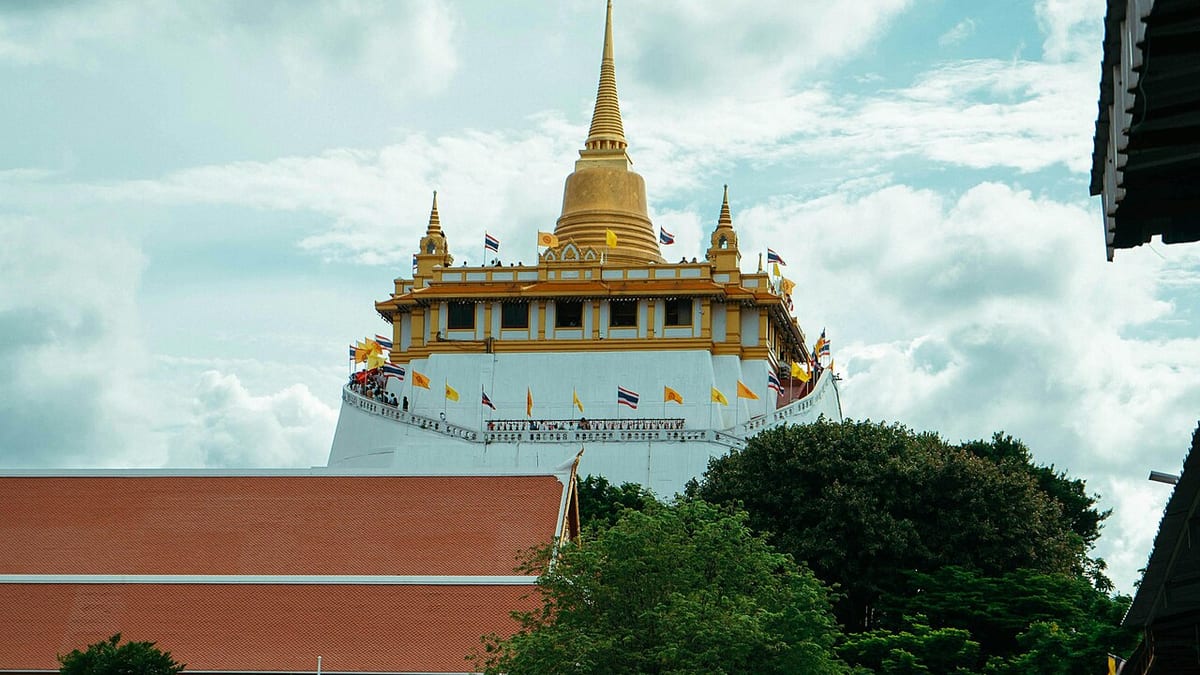
Golden Mount Bangkok is worth visiting when you want an old-town panorama combined with an active temple, and you are comfortable climbing several hundred steps. It is a stronger choice for atmosphere and perspective than for a high-rise skyline experience. Put it early in your day or leave an unhurried afternoon window rather than squeezing the climb between fixed bookings. [1]
The attraction is part of Wat Saket, not a separate mountain excursion outside Bangkok. That makes it a manageable addition to an old-town itinerary, but the stairs are a real consideration rather than a minor detail to discover after arriving.
What makes this different from another temple stop?
The Tourism Authority of Thailand identifies Wat Saket as an Ayutthaya-period temple, later restored and renamed under Rama I. Its Golden Mount provides views across the Rattanakosin area. [1] The appeal is therefore both religious and geographical: you are looking out over the district you may otherwise experience as a succession of streets and buildings.
Treat the climb and the summit as two parts of the visit. You do not need to hurry upward simply because the viewpoint is the most photographed feature. Leave space to pause, notice the surroundings and arrive at the top without immediately needing to turn around.
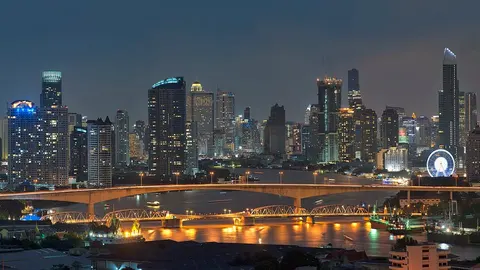
Once there, try to orient yourself before taking a sweep of photographs. Look for the relationship between the lower old-town buildings and the more distant modern skyline. The view is useful precisely because it differs from standing inside a very tall tower; the nearby city remains part of the experience rather than becoming a distant pattern below you.
The chedi contains Buddhist relics, and the site remains a place of worship. [1] Do not treat every part of the upper area as a photography platform. Allow worshippers space, follow local instructions and keep your own route flexible around religious activity.
The stairs should determine who joins the climb
TAT's current description gives a count of 320 stairs. Other visitor descriptions vary, so the practical point is that reaching the upper viewpoint involves more than 300 steps, not a short lift ride. [1]
For an able walker, I would make time for the climb without treating it as a sporting challenge. For someone with difficulty on stairs, the correct question is not how quickly other tourists manage it, but whether this specific ascent and descent fit their capabilities. Do not plan a step-free visit to the summit without direct confirmation of a suitable arrangement.
With children, make the outing short enough that the climb itself remains interesting. A heavy bag, extra shopping and a tight meal reservation all make a simple stop less forgiving. Take only what you need and choose footwear you can confidently use on steps.
In wet conditions, allow more time and follow any access restrictions. There is no benefit in finishing a sightseeing list at the expense of moving carefully. Someone who decides not to climb can still choose a different old-town activity rather than viewing the skipped ascent as a failed day.
The current fee and the opening-hours trap
TAT's indexed official listing gives a foreign-adult entrance fee of THB 100 and opening hours of 7am–7pm. [1] For two foreign adults, the published admission budget is therefore THB 200 before transport or refreshments. Do not substitute an older THB 50 figure from a dated guide for the current listing.
Opening until 7pm should not be interpreted as permission to start an unrestricted visit at 6:59pm. A separate last-ascent deadline was not established from the accessible official information. Arrive with enough margin to climb, spend time at the top and descend without relying on admission in the final minutes.
For planning, allow roughly 60–90 minutes at the site, excluding the journey there. This is an editorial allowance for a leisurely visit, not a measured queue or climbing average. Add more time when your group prefers frequent pauses; shorten the visit by reducing photography time rather than rushing the stairs.
A morning visit is my preferred option when the climb is the main attraction. A later visit suits someone who wants to see the city in changing light, but it needs a less rigid schedule. Do not book a non-refundable sunset-related plan on the assumption that the weather and final admission arrangements will cooperate.
Getting there and choosing the right combination
The official address is 344 Chakkraphatdiphong Road, near the Phan Fa Lilat area. [1] Use "Wat Saket" as well as "Golden Mount" when saving the location or showing a driver the destination. Those names refer to the temple and its best-known feature, not two different places you must travel between.
A local hotel's visitor guide identifies Sam Yot as a useful MRT approach followed by a walk, with a taxi or tuk-tuk offering a more direct arrival. [2] Check the actual walking route from your station exit rather than treating an estimated walk as a guaranteed door-to-door journey, particularly in hot or wet weather.
For an old-town day, pair the climb with one other substantial visit and a meal break. This is more realistic than adding it to a schedule already filled with several ticketed temples. The Golden Mount is especially useful when you would appreciate a change from interior halls to an elevated outdoor view.
Do not assume that two attractions described as being in the old town are immediately beside each other. Save each entrance, not just its landmark label, and compare the walking connection before deciding that another stop is a small addition. A direct ride can be the better choice when your group has already done plenty of walking.
Festival visits are a different proposition
TAT describes an annual temple celebration around Loy Krathong. [3] That gives the site a seasonal dimension, but it is not evidence of confirmed dates, opening extensions or admission arrangements for every future year.
Choose a festival visit because you want the event, not because you expect the same quiet experience as an ordinary morning. Give more attention to meeting points and the route back to your accommodation. For a first visit with a mixed-age group, an ordinary daytime outing may be easier to organise.
Exact festival dates for a prospective trip should come from the temple or a current official announcement. An annual tradition and a dated programme are different kinds of information; one should not be used to invent the other.
Who should prioritise it?
I would recommend the Golden Mount to visitors who enjoy viewpoints with cultural context, have time for the climb and are already spending part of the day in the old town. It offers a clear purpose for a modest admission budget without requiring a long excursion.
Give it lower priority when stairs are unsuitable, when you chiefly want a glass-walled skyscraper deck or when reaching it would displace your main reason for visiting Bangkok. The attraction works best as a deliberate temple-and-view visit - not as an obligatory extra that leaves you rushing up, taking one photograph and rushing straight back down.