Travel from Bangkok to Kanchanaburi by minibus when you want a straightforward town visit, or choose the train when the railway journey is part of the attraction. A private transfer is easier for a group with luggage or several stops. In every case, book for your actual destination: Kanchanaburi town, the River Kwai bridge and a remote riverside hotel are not the same arrival point.
The biggest practical decision is often where you start in Bangkok. Saving a little on the intercity fare is not useful when reaching the departure terminal adds an expensive cross-city taxi ride. Compare the complete hotel-to-hotel journey, not just the advertised time between terminals.
Bus and minibus: choose the departure point first
Kanchanaburi Express publishes services from both the Southern Bus Terminal, Sai Tai Mai, and the Chatuchak minibus station, described as the Mo Chit New Van Terminal. Its example fares are THB 110 from Sai Tai Mai and THB 130 from Chatuchak. The listed journey durations are two and a half hours and three hours respectively. [1]
These are operator listings, not guaranteed arrival times. Add the journey to the terminal, a sensible boarding margin and the final transfer in Kanchanaburi. A nominally shorter intercity ride can produce a longer day when the starting terminal is inconvenient for your hotel.
For two adults, the published return fares work out at THB 440 via Sai Tai Mai or THB 520 via Chatuchak, assuming the same fare in both directions. The difference is only THB 80 for the pair. That calculated comparison makes it clear why terminal access can matter more than choosing the lowest ticket price. [1]
The operator's dedicated timetable displays considerably more departures than the "popular trips" examples on its homepage. Use the timetable and booking results for your actual date rather than concluding that only two buses run each day. The published Sai Tai Mai schedule starts at 05:00 and includes departures through 19:50; availability remains a separate booking question. [2]
With a large suitcase, ask how luggage is carried before paying. A ticket selling a seat does not necessarily guarantee generous space for a rigid case. Confirm the boarding location precisely, especially around Mo Chit, where similarly named transport facilities can create confusion.
The train: an experience, not just a transfer
Regular Kanchanaburi services use Thon Buri station, rather than treating Bangkok's main long-distance terminal as a universal starting point. Published railway guides identify ordinary trains 257 and 259 for the route. Their listed departure times are 07:45 and 13:55, but arrival times differ slightly between sources. Use the State Railway of Thailand's own journey information for the day you travel. [3][4]
The official timetable interface was accessible during research, but its live train rows did not load in a form that allowed every time and fare to be independently checked. For that reason, the times above are useful planning leads, not a promise that a particular connection will operate unchanged.
Choose the train when you are happy to make the outward journey part of the day. Take water and keep the rest of the schedule forgiving. A tightly timed attraction booking shortly after the advertised arrival is a poor match for a leisurely rail outing.
Also distinguish the ordinary service from a booked sightseeing excursion. Thailand's tourism authority describes weekend and public-holiday rail outings to the province, but those are not interchangeable with simply turning up for an ordinary train. [5]
Buying a railway experience requires a different question from buying transport to town: which stretches does the train actually cover, how long does it stop, and what return arrangement is included?
Kanchanaburi is not the end of every Death Railway itinerary
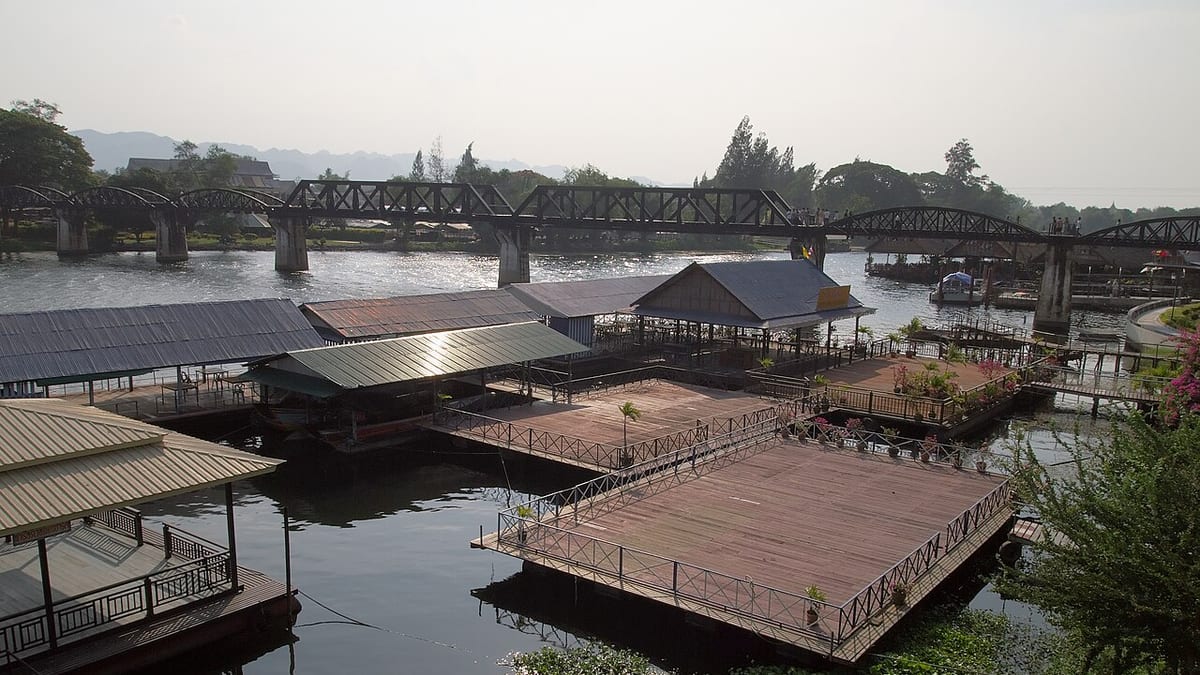
Kanchanaburi town is a convenient base for visiting the bridge and local historical sites, but the railway continues towards other attractions and Nam Tok. A visitor can reach the town without completing the entire scenic route. The tourism authority explicitly presents Kanchanaburi as a base for exploring the surrounding province. [5]
This distinction became particularly important during the flooding of September 2026. An official announcement on 28 September 2026 curtailed trains beyond Tha Kilen because of flooding around Tham Krasae. That was a disruption to a specific section, not evidence that all Bangkok–Kanchanaburi travel had stopped. [6]
Separately, the authorities cancelled sightseeing trains 909/910 for 3–4 October 2026 because of conditions affecting the excursion and Sai Yok Noi waterfall. Those dates are now past. They should not be recycled as proof that the same cancellation remains in force for a later visit. [7]
The useful lesson is to verify the particular part of the railway you intend to ride. Before paying for an excursion beyond town, ask SRT about that section and date; its official notices direct passengers to the train-tracking system or telephone 1690. [6]
For a town-based visit, avoid abandoning the whole trip because an old headline mentions flooding elsewhere in the province. Equally, do not assume that arrival in Kanchanaburi confirms access to every waterfall or onward rail section.
Private transport is best for a dispersed itinerary
A private car or driver is most compelling when your group wants several stops or is staying well outside town. It can remove the need to assemble a chain of terminal transfers, local taxis and hotel pickups.
Request a quotation with the actual addresses and stops. Specify whether you need a simple transfer, a day with waiting time, or a return after dinner. Establish who pays tolls and parking and what happens when the visit runs longer than planned.
For a family, compare the total with all public-transport costs rather than multiplying the intercity ticket alone. Include getting to the Bangkok terminal and from the Kanchanaburi terminal to the hotel. The private option may still cost more, but the comparison will describe what you are actually buying.
A transfer does not automatically include a guide. Someone who drives you between historical sites may not provide interpretation, admissions or an explanation of the wartime railway. Book those services explicitly when they are important.
Make the return journey part of the original booking
A same-day visit is most satisfying with one clear priority: the town and bridge, a particular museum, or a defined railway outing. Trying to combine those with a distant waterfall and a rushed return often leaves too little time at each place.
For a bus day trip, choose the return terminal in Bangkok as carefully as the outward one. "Bangkok" on a booking confirmation is not enough; arrival at Sai Tai Mai and arrival at Chatuchak lead to different onward journeys.
Stay overnight when your main reason for visiting is a riverside setting or a longer excursion outside town. Send your host the exact bus terminal or station where you will arrive and ask for a collection plan.
Finally, avoid putting a long road or rail return immediately before an international flight. An extra night in Bangkok is often a better purchase than a carefully optimised but fragile connection.
Sources
- Kanchanaburi Express: published routes, fares and durations
- Kanchanaburi Express: timetable
- Rail Thailand: Thon Buri–Kanchanaburi service listing
- State Railway of Thailand: timetable
- Tourism Authority of Thailand: Kanchanaburi
- Thai Government Public Relations Department: 28 September 2026 disruption
- NBT: cancellation of 3–4 October sightseeing trains